
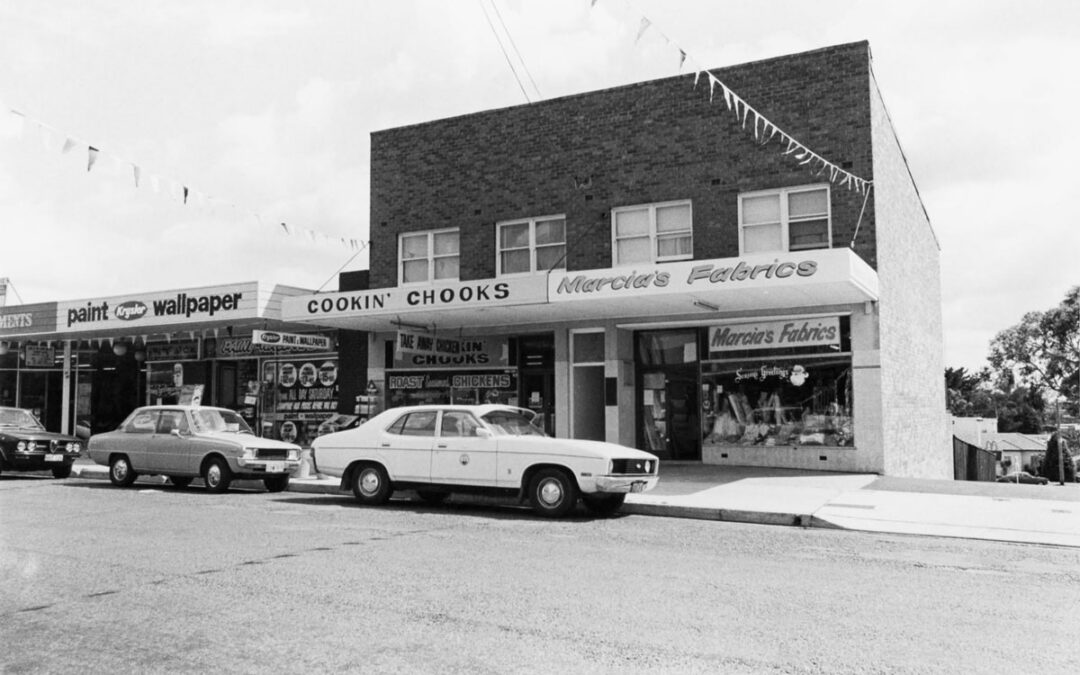
Image credit: Courtesy Sutherland Shire Libraries, Local History collection
Every town has a moment when it stops being a small village and starts becoming a community. For Engadine, that moment stretched across four decades. From the 1960s to the turn of the century, the township that sits on the edge of the Royal National Park gained its own library, high schools, pool, fire station and town centre, and by 1971 was home to more than 18,000 people. It really is the tale of a community that has come of age but still retains the village feel that makes it a special place to work and live.
The highway may have moved, new suburbs named around us, and many of the places we still use every day opened their doors for the first time. This is the next chapter in Engadine history where we explore some of the special milestones that are worth celebrating. Some you may vividly remember, others might surprise you, and all of it helped shape the community we’re proud to be part of today.
Life on One Side of the Tracks
By 1940 there were 23 poultry farms in Engadine, and essential services were thin on the ground. It was a town in its infancy – even the Engadine Bowling club started with humble beginnings on the site that used to be a poultry farm in December 1959, the old chook shed converted into a comfortable clubhouse. In 1951 the local progress association pointed out a problem that would shape the town for decades. The Royal National Park, flanking the eastern side of the railway line, meant Engadine could only develop on one side.
Progress continued to be made as the thriving community began to develop. The shops grew up gradually around the Princes Highway, which for many years was one of the only formal roads in town. Others, like Station Street, were described as little more than “bush tracks.” Hard to imagine that now that so much progress has happened.
If you’ve been around Engadine long enough, you might remember the shops in Station Street in the late 1970s and early 1980s. Marcia’s Fabrics is now Big Red Café, and Cookin’ Chooks is now Caffe Pancetta.
Born in Engadine: Nancy Richmond and San Gerard
If you were born in Engadine before 1971, there’s a good chance you started life at San Gerard Private Hospital. The 10-bed maternity hospital sat on land neighbouring what’s now Engadine Town Park and operated from 1946 to 1971, with Nancy Richmond as owner and Matron. Nancy grew up in Engadine, delivered thousands of babies at San Gerard and raised her own six children on the site. With the closest general hospital all the way over at Kogarah, it was a lifeline for local families.
The hospital closed in 1971. Nancy went on to work in the maternity ward at Sutherland Hospital and later in aged care, retiring at the age of 85. She sadly passed away in 2020, aged 97, and later that year Sutherland Shire Council invited the community to comment on a proposal to name the playground at Engadine Town Park in her honour. You can see a 1950s photo of the gates of San Gerard Private Hospital in the Sutherland Shire Libraries Local History collection.

Image credit: Courtesy of the Local Studies Collection, Sutherland Shire Libraries
Lights Out at the Pictures
The 1960s brought change, and fast. In 1961, the arrival of television had an immediate impact on the Plaza Picture Theatre, which used to be the place to gather in the main street, and sadly it was forced to close.
Moving the Highway
As traffic grew, having the Princes Highway run straight through the shops became a problem. In 1965, plans were made to move the highway away from the shopping centre so the road could be widened. Work began on the early stages of the bypass in 1967, turning Railway Parade into the Princes Highway. By 1969 the new road was finished and the old section through the shops was renamed the Old Princes Highway. It’s a name many of us still colloquially use every day.
Books, Classrooms and a Growing Crowd
1969 was a big year for Engadine. Engadine Public Library opened in Station Street and quickly became a valued service and reference centre for the community. Engadine High School also opened its doors, celebrating its 50th birthday in 2019.
One former student went on to international success. Markus Zusak, author of The Book Thief and The Messenger was educated at Engadine High School and later returned to teach English there for a time. He’s since made his mark publishing several well-known novels. The Book Thief is now published in over 40 languages and has been made into a feature film. What an achievement!
And the people kept coming. By 1971, Engadine’s population stood at 18,183. Crown land was released at regular intervals, particularly in north Engadine, and new families kept arriving. The neighbourhoods around us were taking shape too. On 29 November 1971, Council raised no objection to the naming of Yarrawarrah, a name meaning “Mountain Ash” that refers to a range of hills in the area. Woronora Heights followed, named in 1982 as development there got under way.
The Town Comes of Age
The decades after 1971 brought a steady stream of new and improved services. In 1975, an Olympic pool opened in Anzac Avenue, which is now called the Engadine Leisure Centre, a well utilised service by many in the community.
In 1978, St John Bosco College was founded by parishioners of St John Bosco Parish, working with the Salesian Fathers and the Catholic Education Office, Sydney. It began as St John Bosco High School for Years 7 to 10 and became St John Bosco College in 1998, when its first Year 11 students enrolled.
Getting in and out of town got easier from 1980, when the suburban railway line was electrified through to Waterfall. A purpose-built police station opened in Caldarra Avenue in 1981. And at Anzac Oval, the completion of stages 1, 2 and 3 of the complex in 1988 was largely thanks to the work of members of the Apex Club of Engadine. It’s a great example of locals rolling up their sleeves for their own community. Even the environment got some attention, with artificial wetlands created in the Royal National Park near Engadine station in 1994, and opposite Engadine Avenue in 1997, to help reduce pollution.
Shops, Cafés and a New Town Centre
In 1990, the first mall was established in the town centre when Engadine Court opened for business. Today, we refer to the location as Engadine Town Square Shopping Centre. Around the same time, a community centre opened opposite the mall, housing facilities such as childcare and, later, the new Engadine Library, which opened in 1998.
Another local landmark with a long story is the site of the old Women’s Rest Centre. It was redeveloped and, in 2010, became the Engadine Community Centre, with a 316-seat performance space that hosts theatre, school concerts and dance performances. It’s also home to Engadine Community Services, which supports seniors, families and the wider community.
Celebrating Where We Came From
As Engadine grew, it never lost sight of its roots. In 2000, the first McAlister Day Fair was held, named in honour of the pioneer Charles McAlister. As the Dictionary of Sydney puts it, “A community spirit still drives local residents to continue to improve the area, while the past is also celebrated.” We couldn’t have said it better.
Many of the moments in this story are also recorded in the Club’s own history book, a reminder of how closely the Club and the community have grown together.
Acknowledgement of Country
Engadine sits on the traditional country of the Tharawal people. We acknowledge their elders past, present and emerging, and recognise that their connection to this land never ended. The story of this place belongs to them first, and we are grateful to be part of the community that continues to grow here.
Read next:
Sources
- Dictionary of Sydney, Engadine entry, Helen McDonald, 2008
- Engadine Bowling Club history book (Plaza Picture Theatre, fire station, highway bypass, Anzac Oval)
- Sutherland Shire Council, Proposal to name the playground at Engadine: Nancy Richmond
- Sutherland Shire Libraries Local History, San Gerard Private Hospital (ca. 1950s)
- Sutherland Shire Libraries Local History, Engadine Public Library
- Sutherland Shire Libraries Local History, Yarrawarrah naming, Council minute 29 November 1971
- Sutherland Shire Libraries Local History, Engadine Swimming Pool
- Sydney Catholic Schools, St John Bosco College Engadine founded
- Sutherland Shire Libraries Local History, Engadine Shopping Centre (1980s)
- Sutherland Shire Libraries Local History, Engadine Shopping Centre (circa 1990s)
- Sutherland Shire Libraries Local History, Women’s Rest Centre
- AustLit, Markus Zusak